Tuesday, 15 November 2011

A Tale of Two Leaders


The condition of co-dominance occurs when two leaders, or main upright branches, of a tree are of the same size. Some trees naturally have a strong central leader. Species like pin oak, sweet gum and white spruce are typical examples. These species can display co-dominance when pruning removes the dominant leader. When this occurs one or more new leaders will take on the role and start to compete. This leads to bark being included in the narrow “V” crotch between the two leaders. Over time this union becomes weaker and weaker as the tree grows apart.

Given the right conditions the two leaders will separate as the bark in the crotch splits and the tree tears itself apart. When the tree has been torn it is unable to form the protective boundaries that prevent decay from entering into the remaining leader. The weakened leader decays at an accelerated rate and can fail in an unpredictable manner.

Timely pruning of young trees prevents this condition from developing and causing major problems later in the trees life. If the condition already exists, cabling and bracing can help to prevent catastrophic failure and extend the life of mature trees. These measures are not complicated but need to be performed by a skilled technician. It can be quite interesting and even Gothic, the measures that people will employ to prevent their trees from splitting. The correct, effective solution of cabling and bracing are so subtle and non-obtrusive, that I have been called out on many occasions to point them out. Not so with the logging chains, mummy cables, steel welded bars, and other assorted paraphernalia I have seen used in less successful attempts.

Recently I was called out to look at a tree that I had on two occasion’s recommended remedial action to stabilize it. The tree, a mature Red Oak, had been covered with 6 inches of snow while in full leaf. The resulting stress pulled the 20 inch oak stems apart like pealing a banana. How unfortunate that the home owner declined to spend the small amount it would have taken to keep this 200 year old tree growing for another 100 years. Now they are faced with the cost of removing this giant tree a prospect many times more expensive than the original preventative action. A case of, “a stitch in time saving nine” if ever there was one. I.S.A. Certified Arborists are trained to identify and recommend corrective action to prevent the destructive forces that can be released in a co-dominant leader failure.

Saturday, 15 October 2011

We Can Spare Some Green for the Forest!


Trees and green space provide real quantifiable benefits to urban environments. People can exist for years, life times some times in environments void of green space and nature. We call these environments prisons, jails and , penitentiaries. Part of the penal punishment process is the intentional removal of all these natural things that contribute to the human experience.
The results of this de-naturalization are predictable and well documented in both institutional and traditional housing situations.
Increased violence, isolation, decreased sense of well being and increased crime and suicide rates among youth.
The point being made is why would we allow residential rental housing to be built without mandating minimum provisions for setbacks, green space ,parks and recrea tional facilities.
Have our urban planers all gone for lunch at the same time? I suspect not!
Given the space, private home owners in all cultures develop their own gardens for their recreation and even landscape their front yards to create attractive vital neighborhoods.
In our home towns we need to advocate for the building of neighborhoods and the end of rental housing wear houses.
Green space is the catalyst for neighborhood and community development.
Central Park in New York City revolutionized the concept of protected, preserved, public space for all the inhabitants of the city to enjoy. It has been under development pres sure from before it's construction and continues to need vigilant protection.
Real-estate development is a business and rightfully is concerned with maximizing profits for share holders. Planning boards and urban planers act on direction from city co uncils who are elected by their constituents. People must be willing to step forward to make sure guidelines are in place to create urban neighborhoods and not allow tracts of housing wear-houses to be built. With no green space or recreation facilities mandated into development plans we will be left with socio-cidal landscapes with increased crime, higher youth, and domestic violen ce and ultimately the ghettoization of our cities.
These issues will add to policing and other public service cost increases. And as public service implies the costs of theses dysfunctional landscapes will be passed on to we the people.
Pennies lost on increased development costs will result in dollars saved in long term social costs.
And the result will be better, safer neighborhoods with increased property values.
Put in trees, sidewalks, play spaces and people want to stay, interact and form communities.
ISA Certified Arborists know the values of well placed green assets.
Many consult with developers and urban planners to help our cities to be as healthy and growing as the trees within them.

Thursday, 15 September 2011

Major Cuts


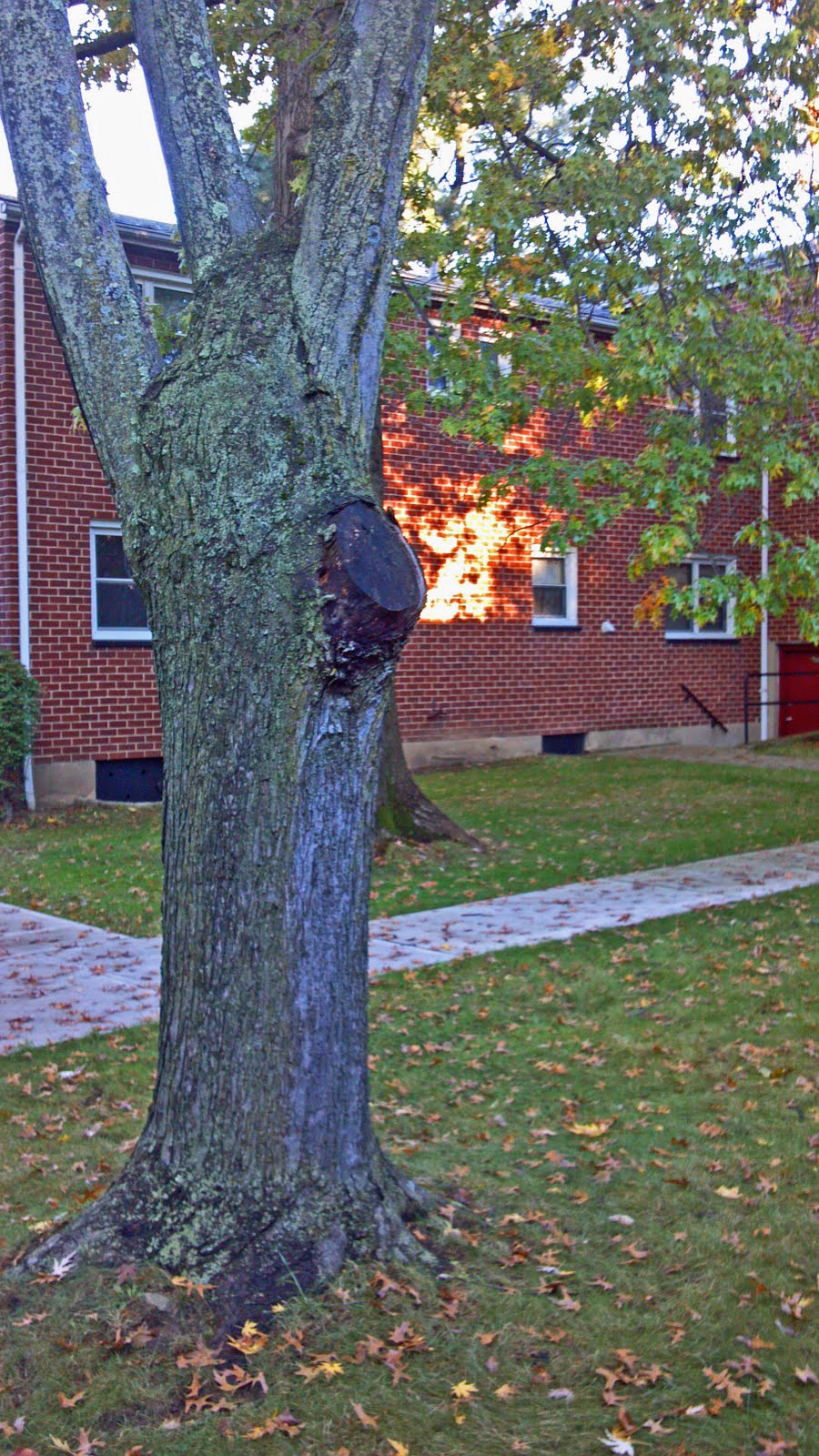
Far from the latest denizen of destruction for the social safety net this article focuses on one of the most destructive practices in pruning. Removing large limbs or whole stems is destructive and can lead to major tree failures. This can be in the short term or even more dangerous, in the distant future.

The scenario usually involves a structure, like a home or garage that is being built or added on to, realizing the beauty and utility of a stately mature tree the home owner decides to locate the addition close to an existing tree. The dialog usually goes like this

” I would like to build X right next to this tree and the builder says that that major limb has to go so it won’t hit the roof/wall/door”. “I need to have this 14 inch limb removed 10 feet up in this 60 foot maple tree”. What I would like to reply is “Can you move the garage over to the other side of the property where there are no trees? “ But not wanting to come off as a smart Alec I will try to explain the consequences.

Making major cuts on the main stem of a healthy tree opens the trunk up to invasion by wood decay organisms and creates structural instability in the entire tree. Trees prevent decay by compartmentalizing the damaged wood. They produce rot resistant barriers using chemicals that the tree fabricates at considerable expense. The tree doesn’t head out to the hardware store and buy turpentine or stain it literally makes it! It doesn’t put it all on the credit card either however it uses its precious energy stores to create these protective bio chemicals. Then it concentrates these protectors in cells near the injury. Once these cells have been used as protective barriers they die and become nonfunctional to the tree. It is a very energy expensive process. These protective zones can be hundreds or even thousands of cells deep. They disrupt the normal flow of nutrients and the tree has to grow over them to close the wound. This will take many years and when it has grown over, the tree will have a large hidden defect that can break unexpectedly. The results can be catastrophic not only for the tree but for the structure that has been built so close to the compromised tree.

There is good evidence and many studies that also show that the removal of large limbs causes internal stress that can crack the interior wood of the tree and weaken its structural integrity. In nature major limbs rarely break and when they do as a result of extraordinary force, they break far away from the trunk and prevent decay from entering the main stem. Many times after storms the trees that fail are ones that have been pruned drastically low on the trunk in the past. Please consider all the options, including complete removal, before making these types of cuts. The practice of painting wounds is not first aid and would require an entire article to explain why it often does more harm than good.

If you are considering construction close to mature trees contact your ISA Certified Arborist to develop comprehensive pruning plan.

Monday, 15 August 2011

Circled Roots


I spend the majority of my time examining trees. And I really like that! However lately I have been noticing more and more trees with circled or girdling roots. The outward expression of this condition can be very obvious, a large root or group of roots circling a tree above the surface of the soil quite clearly strangling the life out of the tree above. Or it can be practically un-noticeable, a buried root that circles around below the soil level choking the life out of a seemingly healthy tree. And the signs can also include thinning tree crown and eventually die back. Trees generally have a pronounced widening at the point where they enter the ground, called the basal flare. The tissue at the base of the tree is a mixture of trunk tissue and root tissue that is very tough and resistant to insects and decay. If you have ever burned piece of a stump it takes forever. If you have tried to chop a stump out with an axe you will know how tough this tissue is. In fact one of the most common ways to remove a stump is to grind it out like you would grind a rock.

Root tissue is different from this transitional trunk flare tissue and will not join or graft to it when they come in contact. When the root tissue tries to grow over the trunk tissue, the tissues continue to expand compressing the trunk tissue. The phloem in the trunk tissue, the outermost layer of living cells is responsible for transporting sugars back down to the roots from the leaves where it if produced. The phloem becomes blocked and compressed by the root pressing against it and results in further swelling above the blockage. This continues until the tree completely blocks itself or the root is removed.

This past weekend I purchased a Japanese black pine on a standard, while I was planting it I discovered several girdling roots. Fortunately they were small and I was able to remove them with a pair of pruners while I was planting it.

The lesson learned is that even small trees can have potentially large problems. You must carefully examine their roots and take corrective actions. Roots should move away from the trunk in a pattern resembling the spokes of a wheel. If they circle back or cross other roots sideways to the trunk, problems may be looming.

Three seasons ago we were able to identify a potentially fatal root conflict on a Dawn redwood. We were able to excavate the root collar with high pressure air and carefully remove the root. Typically the results are slow to show, however this particular redwood made such a remarkable recovery, you can barely see where the root was circling the trunk. If appropriate timely action is taken the problem can be averted and the trees life extended.

If you have trees with troubled roots contact your ISA Certified Arborist to develop a root recovery plan.

Thursday, 28 July 2011

Root Grafts and Dutch Elm Disease


This isn’t the first or the last article written on Dutch elm disease. Tragedy strikes when I see a formerly healthy elm tree stricken by this typically fatal disease. The horror scene, leaves turning yellow and brown and clinging tenaciously to its expired vase like form.

Dutch elm disease is a fatal vascular disease that infects and kills North American Elm trees. This fungal disease Ophiostomata Ulmi is spread from tree to tree by Elm bark beetles. The disease travels long distances by bark beetles living and breeding in Elm fire wood.

For many years I would mark one or more trees for removal in this one shelter belt of trees in my survey area. The City would come quickly and remove the tree to prevent the spread of DED to the next tree in the row. The following year we would come out and the next tree in the row would be showing signs of a late season infection. These typically are small stunted leaves that emerge, turn brown and die quickly. This differs from the more typical late season infection where a healthy normal tree has a branch or two that suddenly turn yellow and brown. Some leaves drop but many are left With hanging on the branch. This symptom is called “flagging”. Late season infections trees sickly and stunted die early in the season.

Late season infections are typically caused by overwintering elm bark beetles spreading the disease spores as they burrow into the trees bark. This direct injection of Dutch elm disease directly into the vascular system of the tree overwhelms the tree causing death the following spring.

The row of trees was being treated successfully year after year to reduce the population of overwintering elm bark beetles and no other trees in the row were affected, just adjacent trees.

The only possible way for the trees to become consistently infected was through root grafts. Root grafts occur between trees, typically of the same species, where the roots come in contact with each other and physically bond. Trees pass fluids, like sap, electrical signals and bio-chemicals between them through these grafts. Unfortunately root grafts also allow diseases like Dutch elm disease to pass between trees. Once you take the diseased tree down the sap flows back through the roots and into the next living tree grafted to the infected tree that was removed.

We finally broke the chain of infection by taking down the infected tree and the next two uninfected trees in the tree row. The next year the remaining trees were uninfected and remain alive to this day. Roots can also be root pruned and separated using a deep plow, trencher or ideally by excavating with high pressure air. If you have elm trees on your property contact your ISA Certified Arborist to develop a disease management plan.